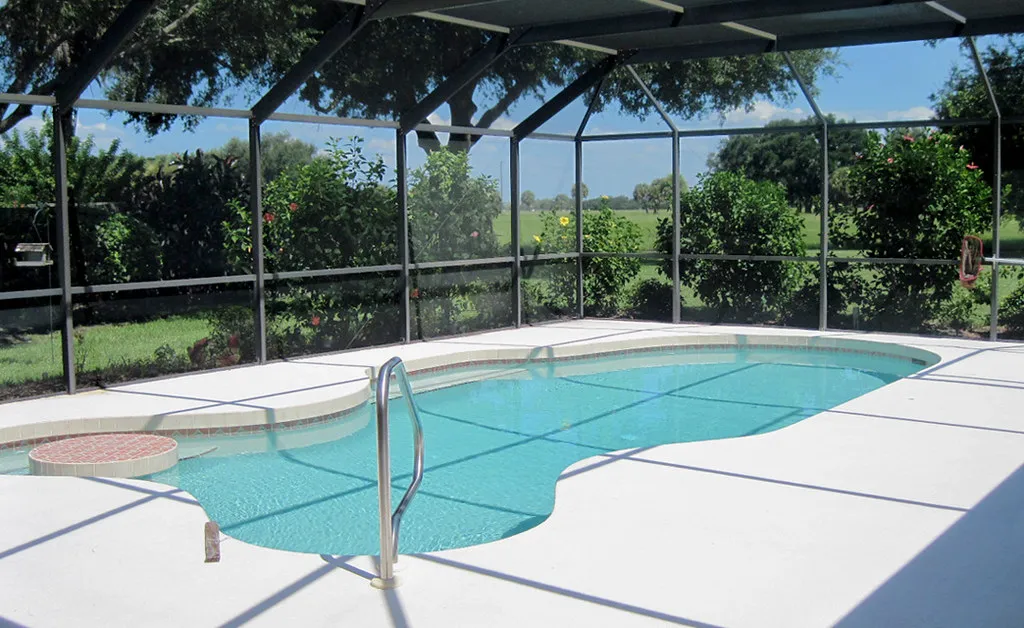
This guide was written for us by our friends at Spotless Cleaning Services and More, a family-owned exterior cleaning company serving Bradenton, Sarasota and Lakewood Ranch. They clean pool areas for a living; we build and rescreen the cages over them. Between us, that covers the whole job.
A pool cage in Florida does more work than most homeowners realize.
It keeps insects and debris away from the pool, makes the outdoor space more comfortable, and creates a barrier between the pool area and everything the Florida environment throws at it. At the same time, the enclosure itself is constantly exposed to sun, humidity, rain, pollen, organic growth, irrigation water and storms.
That makes proper maintenance important.
A quality pool cage can last for years, but the screen, aluminum frame, fasteners and pool deck do not all need the same kind of care. Knowing what to clean, what to inspect and when something actually needs repair helps you get more life out of the entire enclosure.
Start With the Screen, But Know What Type You Have
Not all pool cage screens are the same. The mesh on your enclosure affects insect protection, airflow, durability and how the screen should be treated over its lifetime. Best Screen Enclosure installs several screen options for Southwest Florida homes:
- 18/14 Standard Screen is the traditional choice for pool cages and patios. It gives good insect protection with plenty of airflow, it is economical, and it works well for homeowners who do not have a serious problem with very small insects.
- 20/20 No-See-Um Screen uses a finer mesh. The tighter weave keeps out smaller insects such as no-see-ums, gnats and sand flies, which makes it particularly useful in parts of Southwest Florida where they are a constant problem.
- 16/14 PVC-Coated Screen is made from polyester yarn with a PVC coating. It is significantly stronger than traditional fiberglass screening, for homeowners who want a more durable, longer-lasting material.
- 17/20 PVC-Coated Screen combines a finer weave with the strength of PVC-coated polyester: better protection against small insects, in something tougher than conventional fiberglass no-see-um screening.
There are also specialty screens for pets, privacy and other uses. You can compare them all on our screen types page.
Do not assume every pool screen is the same material just because it looks similar from a distance. If you are thinking about replacing older screens and are not sure which material makes sense for your property, the Best Screen Enclosure team can help you weigh insects, pets, airflow and durability against how you actually use the space. Call (941) 676-8818 for a free estimate or a screening recommendation.
Dirt on a Pool Screen Is More Than a Cosmetic Problem
A dirty pool cage is easy to ignore because the buildup happens gradually. A little green discoloration appears in one corner. Pollen collects on the mesh. Dirt accumulates along the lower panels. Before long, what looked like a minor cosmetic issue has become a layer of organic material covering parts of the enclosure.
That buildup affects more than appearance.
When dirt, algae and organic material stay embedded in screen mesh, they hold moisture and contaminants against the material. This matters most with traditional fiberglass screening. With contamination trapped in the mesh and Florida’s heat, humidity and UV working on it, standard fiberglass can gradually deteriorate and lose its integrity. Eventually, older fiberglass screening can become brittle and much easier to tear.
Cleaning will not make an old screen new again, and it cannot fix mesh that has already deteriorated. What routine cleaning can do is remove material that does not belong there, and make it easier to spot deterioration before a small problem becomes a failed panel.
For homeowners who would rather not handle this themselves, Spotless Cleaning Services and More provides professional pool cage, screen and exterior cleaning throughout Bradenton, Sarasota, Lakewood Ranch and surrounding areas. The family-owned company is a Gold Award Winner for Exterior Cleaning in Bradenton’s Best People’s Choice Magazine, and can be reached at 813-606-7589.
Rinsing May Be the Most Important Part of Screen Cleaning
Homeowners frequently underestimate this. Cleaning a screen is only half the job. Rinsing it extremely thoroughly is just as important.
If a detergent, surfactant or cleaning solution is used on an enclosure, it needs to be thoroughly rinsed from the screen and the surrounding surfaces. Even a small amount of surfactant left behind can leave a residue that attracts and holds pollen, dirt and dust. The result is frustrating: the cage was just cleaned, yet the screens seem to get dirty again unusually quickly.
The problem may not be the cleaning itself. It may be what was left behind.
When you clean pool screens, take the extra time to rinse the mesh from both sides wherever you can reach. Pay particular attention to corners, spline channels, framing intersections and the lower panels where runoff collects. The goal is not to rinse until the visible soap disappears. The goal is to remove the cleaning solution and its residue from the surface.
Proper rinsing makes a major difference to how the enclosure looks afterwards, and to how quickly airborne dirt starts sticking to it again.
More Pressure Is Not Better
A pool cage is not a concrete driveway. Screen mesh, spline, painted aluminum, fasteners and structural connections all have different limits.
Too much pressure directly against screening can stretch the material, loosen the spline or ruin an otherwise serviceable panel. Older fiberglass deserves even more caution, because age and UV exposure may already have reduced its strength. A screen can look intact while having far less strength than it did when it was installed.
The safest approach is the least aggressive cleaning method that will do the job, especially on older enclosures.
Cleaning should preserve the enclosure, not test how much force the mesh can withstand.
Do Not Forget the Aluminum Frame
The screen gets most of the attention, but the aluminum structure needs inspecting and maintaining too. Look for:
- Green or black organic growth
- Dirt collecting around framing joints
- Loose or missing fasteners
- Corroded screws
- Damaged or chalking finishes
- Loose spline
- Sagging screen panels
- Cracks or movement around attachment points
- Areas where water continually collects
Florida’s coastal environment makes fasteners especially important. Salt, moisture and heat are hard on metal components even when the aluminum framing itself is still structurally sound.
Cleaning the frame also makes inspection easier. Corrosion, failing finishes and loose hardware are much easier to recognize when years of dirt and organic buildup are not covering them.
If cleaning reveals bent or damaged aluminum, significant corrosion or questionable structural connections, that has moved beyond routine maintenance. Best Screen Enclosure provides aluminum frame repair and other enclosure repairs throughout Southwest Florida. If you find damage while cleaning or inspecting, call (941) 676-8818 to have the enclosure looked at.
Know the Difference Between Cleaning and Repair
Cleaning can dramatically improve how a pool cage looks, but some problems no amount of cleaning will correct. A torn panel needs replacing. Spline pulling away from the frame needs attention. Panels that keep sagging may need rescreening. Corroded or failing structural components should be evaluated, not just cleaned.
And if the aluminum structure itself has deteriorated, the right answer may be very different from replacing a few screen panels. This is where having an enclosure specialist involved matters.
Best Screen Enclosure installs, rescreens and repairs pool cages and lanai enclosures throughout Southwest Florida. An enclosure can often be repaired or rescreened when the aluminum is sound, while more significant structural deterioration may justify more extensive repair or replacement. We can help you work out whether you are looking at a single panel, a full rescreen, an aluminum repair or a bigger project. If you have torn panels, sagging screens or damaged framing, call (941) 676-8818 for a free estimate.
Catching these problems early gives you more options.
The Pool Deck Is Part of the Maintenance Picture Too
Homeowners often clean the cage and forget about everything underneath it. Your pool deck is exposed to many of the same conditions as the enclosure:
- Moisture
- Organic growth
- Foot traffic
- Sunscreen
- Spilled drinks
- Landscaping debris
- Pollen
- Dirt carried in from outside
But the right cleaning method depends heavily on the deck material. Concrete, decorative concrete, pavers and coated surfaces should not automatically be treated the same way.
Before cleaning a pool deck, identify the surface and find out whether it has an existing coating or sealer. The wrong pressure or the wrong cleaning chemistry can cause a much bigger problem than the dirt you were trying to remove.
This is another area where professional maintenance makes sense. Spotless Cleaning Services and More cleans pool cages, pool screens, pool decks, concrete and pavers, and matches the cleaning process to the surface. For professional pool-area cleaning, call 813-606-7589.
Pavers Need Their Own Maintenance Plan
Pavers around a screened pool are especially common in Florida. They can develop algae, weeds, joint-sand loss, staining and sealer problems.
Routine cleaning controls surface contamination, but keep an eye on the condition of the joints and any existing sealer too.
If the pavers are going to be sealed or resealed, preparation matters even more. The surface has to be properly cleaned, the existing sealer has to be evaluated, and the pavers need enough drying time before new sealer goes on. Sealer over poorly prepared pavers can trap problems underneath rather than solve them, and pool areas tend to stay humid and damp longer than the rest of a property.
Watch for Irrigation and Hard-Water Staining
Another common Southwest Florida problem has nothing to do with the pool itself: sprinklers.
Repeated irrigation overspray leaves mineral deposits and staining on screens, aluminum framing, pavers and concrete around the enclosure, and those deposits get much harder to remove the longer they build up.
If sprinklers regularly hit the enclosure, redirecting them is part of the maintenance. Otherwise, cleaning the stain without fixing the source means it will simply come back.
Fix the cause when possible, not just the symptom.
How Often Should a Pool Cage Be Cleaned?
There is no single schedule that works for every Florida property. An enclosure surrounded by trees collects organic debris much faster than one in an open yard. A home near the coast has different exposure than one farther inland. Irrigation, shade, screen type, landscaping and airflow all make a difference.
A practical approach is to inspect the enclosure regularly rather than waiting for a date on the calendar. A light rinse removes loose pollen and debris before heavy buildup develops. Professional cleaning becomes worthwhile when organic growth is established, the enclosure is hard to reach safely, the frame has substantial buildup, or the deck and enclosure need cleaning together.
The key is not letting years of buildup accumulate before doing anything.
When Professional Pool Cage Cleaning Makes Sense
Some pool cages are easy to maintain from the ground. Others are not. Two-story enclosures, large roof panels, established organic growth and hard-to-reach framing can turn a simple-looking job into something much more involved.
Professional cleaning also makes sense when several different surfaces need attention at once. A single pool area may contain:
- Screen mesh
- Painted aluminum
- Concrete
- Pavers
- Coated pool decking
- Natural stone
- Other exterior materials
These surfaces can sit within a few feet of one another, yet each may need a different approach. Professional exterior cleaning should never mean applying the same pressure and the same solution to everything.
For homeowners in Bradenton, Sarasota, Lakewood Ranch and surrounding areas, Spotless Cleaning Services and More provides maintenance cleaning for pool cages, screens, pool decks, pavers and other exterior surfaces. To talk about cleaning your enclosure or the area around your pool, call them at 813-606-7589.
Whether the enclosure is cleaned professionally or by the homeowner, what matters is matching the process to the material rather than treating the whole pool area as one surface.
Inspect the Cage After Cleaning
One of the best times to inspect a pool cage is right after it has been cleaned. With the dirt and organic buildup gone, look closely at the mesh: small tears, separation around the spline, sagging panels and areas that look unusually brittle.
Then look at the structure:
- Fasteners
- Doors
- Frame connections
- Spline
- Corners
- Structural attachment points
- Areas showing corrosion or movement
A small screen repair today is generally better than waiting until a damaged panel tears further, and the same goes for hardware and structural issues. Cleaning often reveals problems that were hidden under dirt and algae. For more on what to look for, see signs your pool cage needs repair.
If cleaning reveals damage, that is the point where a screen enclosure professional should take over. Best Screen Enclosure handles individual panel replacement, full rescreening, aluminum frame repair and new pool cage installation. If an inspection turns up something you are not sure how to address, call (941) 676-8818 to talk through what you are seeing and the right next step.
Maintenance and Rescreening Work Together
Eventually every screen reaches the end of its useful life. Maintenance is about getting a reasonable service life out of the material and catching problems before they grow. It is not about making old screening last forever.
If a few panels are damaged and the rest of the enclosure is in good shape, replacing those panels may be enough. If the screening throughout the cage has become brittle, torn or loose while the aluminum is still sound, a full rescreen may make more sense. And when the aluminum structure itself has significant problems, the conversation changes again. Our guide to rescreening versus replacement goes into that decision in more detail.
Best Screen Enclosure will look at whether your enclosure is a candidate for repair, full rescreening or replacement, rather than assuming the whole cage needs to be rebuilt. If you are unsure which one you need, call (941) 676-8818 or schedule a free estimate.
A Little Maintenance Protects a Large Investment
A pool cage is a system. The aluminum supports the screening. The screening protects the pool area. The deck is the usable space underneath it. Fasteners, spline, doors and structural connections keep everything working together. Maintaining one part while ignoring the others eventually shows.
Keep the screen reasonably clean. Rinse cleaning products off extremely thoroughly. Avoid unnecessary force against the mesh. Inspect the aluminum and fasteners. Keep the deck and pavers maintained. Fix irrigation problems when you find them. And pay attention when cleaning or inspection reveals damage that needs a professional.
- When the enclosure needs professional cleaning and exterior maintenance, Spotless Cleaning Services and More, a Bradenton’s Best People’s Choice Gold Award Winner for Exterior Cleaning, can help at 813-606-7589.
- When screens are torn, spline is failing, panels need rescreening, aluminum needs repair or the enclosure needs replacing, Best Screen Enclosure can help at (941) 676-8818.
Knowing the difference between maintenance and repair is one of the best ways to protect the entire pool area. Proper installation, sensible maintenance, appropriate cleaning and timely repairs give a Florida pool enclosure the best chance of serving your home for years to come.
Header photo: “Sarasota - Swimming Pool (2010)” by Roger W, licensed under CC BY-SA 2.0. Cropped to fit.


